Free estimates. Text us photos and we will send you a price.
Indigenous and Italian-owned. 10+ five-star reviews. — EST. 2024(807) 633-0653
Precision Concrete Ltd — concrete contractor in Thunder Bay, Ontario
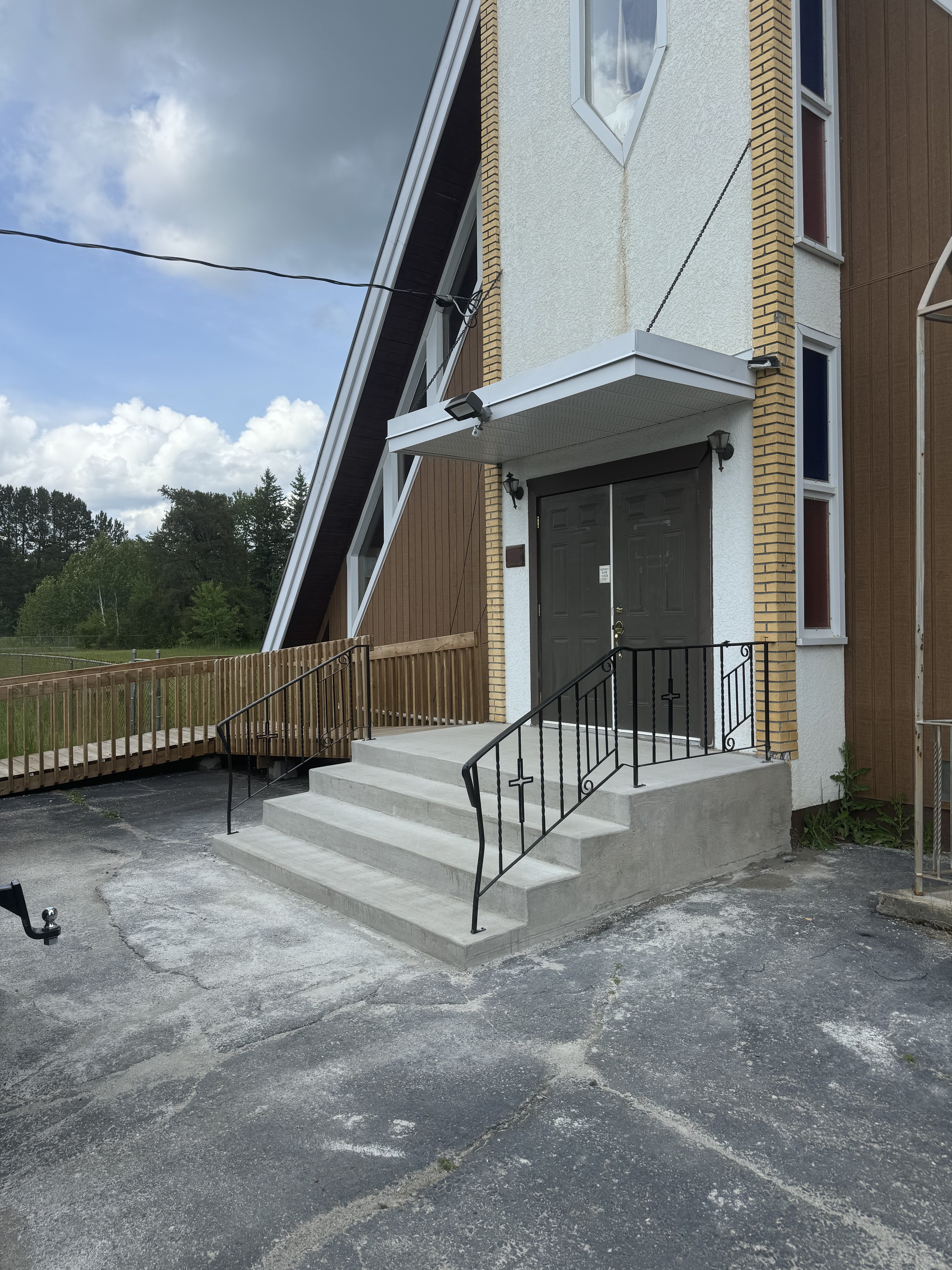
Poured concrete steps and landing built in Thunder Bay, Ontario
Steps and stairs

Concrete Steps and Stairs in Thunder Bay, ON

Crumbling front steps, a set that has pulled away from the house, or a riser that is now taller than the rest. We will look at yours and tell you whether it needs replacing or not.

Footings carried below frost, not floated on gradeBroom finished treads for winter gripSatisfaction guarantee on our work

Send a few photos and we will send you a price.

Photos (optional)Add up to 3 photos of the area — it helps us price faster. Totally optional.

Front Steps Are the First Thing Frost Takes

01A gap opening between the steps and the house wall
02One riser now noticeably taller or shorter than the others
03Crumbling and flaking along the tread edges
04A visible void or washed-out cavity under the bottom step
05The whole set tilted forward, backward, or to one side
06A railing that has gone loose because its base has moved
Client testimonials

Precision Results.

5-star ratings from Google

Ryan Doucette

5 reviews · 4 weeks ago

“This company is great. Hard working guys who make sure you end up with a great result. Very experienced workers who can adapt to any job you throw at them!”

Robert McCollum

1 review · 4 months ago

“Had a beautiful patio done for my parents in their backyard, stamped and sealed. Looks fantastic and very professional/efficient crew! 10/10 and would highly recommend!”

Aaron Whipple

2 reviews · 6 months ago

“They did an amazing job. Definitely recommend them if you're looking for a concrete contractor in Thunder Bay.”

Ethan Chiodo

2 reviews · 6 months ago

“Precision Concrete did an outstanding job. Professional, reliable, and top-quality work from start to finish. Tyler and Johnny were great to work with and made sure everything was done right.”

Hugo Petrone

1 review · a year ago

“Excellent work from Tyler and Johnny. I was blown away from start to finish with their attention to detail and overall craftsmanship. If you want your job done right, call precision concrete.”

Verified reviews from our Google Business Profile

Read our Google reviews
What's included

Concrete Steps in Thunder Bay: What to Expect


Most people who call us about steps do not actually want new steps. They want to know whether they need new steps. Those are different questions and we answer the first one before quoting the second, because a set that is cosmetically rough but sitting on a sound footing is a very different situation from a set that has lifted, and the second one cannot be patched into behaving like the first.

First, what is actually wrong

We look at what is moving rather than at what looks bad. Surface damage on the treads, crumbling nosings, and flaking is usually salt and freeze-thaw attacking the concrete surface, and it can be ugly without being structural. Movement is the other category: a gap opening at the house, risers that are no longer equal, a tilt, or a washed-out void underneath. Movement means the footing or the ground beneath it has changed, and no amount of surface work addresses that. We will tell you which one you have and we will tell you if the answer is that you can leave it another few years.

Then, if they need replacing

New steps get a footing carried below the frost line and tied to it, not a pad poured on grade. This is the whole ballgame in Thunder Bay. Frost here goes deeper than almost anywhere in Ontario, the Building Code sets the depth by local determination rather than by a provincial table, and steps poured shallow are the single most common reason a homeowner is looking at a failed set fifteen years early. Where the steps meet the house, a full-depth isolation joint goes between them, filled with a compressible material rather than poured tight to the wall. The house and the steps move independently through a freeze cycle, and concrete poured hard against a foundation transmits that movement straight into the wall. That joint is why a properly built set pulls neither away from nor into the house. The concrete is the salt-rated class, 32 MPa with 5 to 8 percent entrained air, which Concrete Ontario specifies for steps and porches by name. Treads get a broom finish. A troweled smooth tread is both a worse surface to stand on in February and a surface that eventually peels, because troweling air-entrained concrete drives the air out of the top layer. Risers get built to a consistent height, which matters more than people expect: a stair with one riser out of step with the rest is the one people trip on, because feet stop measuring after the second step.

Curing runs at least seven days and you will need another way in for about a day after the pour. No de-icer at all the first winter, sand instead, which is genuinely awkward on the one surface you most want to treat. Handrails and whether one is required on your set is worth sorting out at the quote. Our satisfaction guarantee covers coming back out for hairline cracking and joint spalling.

Why us

Why Thunder Bay Calls Us About Their Steps


We will tell you not to

Some sets of steps look terrible and are structurally fine for another decade. If that is yours, we will say so and leave. Assessments are free and we are not paid to find work.

Footings below frost

The old set most likely failed because it sat on a pad instead of a footing carried below the frost line. Frost here goes deeper than nearly anywhere in Ontario. Building to that depth is the entire difference.

Joint between steps and house

A full-depth isolation joint goes between your new steps and the foundation. The two structures move differently in a freeze, and giving them somewhere to do it separately is what stops the gap coming back.

If it is not right, we come back

Twelve months is the Canadian norm and most exclude cracking entirely. Ours is a satisfaction guarantee: call an owner and we come back out.

Process

What to Expect When We Look at Your Steps


  1. Free assessment, not a sales call

    We come out and work out whether the problem is surface damage or actual movement, then tell you which one it is and whether it needs doing now.

  2. Plan and written estimate

    If replacement is the answer, you get a written estimate covering demolition, footing excavation and depth, forming, concrete, finish, and the isolation joint at the house.

  3. You approve, we schedule

    We book you in and confirm the pour window. We will also sort out how you get in and out of the house while the old set is gone.

  4. Break out, excavate, form, pour

    The old set comes out, the footing is excavated below frost and poured, then the steps are formed and poured on it, treads broomed, isolation joint set against the house.

  5. Walkthrough and your approval

    We go over how long to stay off them, the first-winter sand rule, and the handrail if there is one, and you sign off before we leave.

Pricing

How Much Do Concrete Steps Cost in Thunder Bay?


The number of risers is the obvious variable and the footing is the one that actually moves the price. A set of steps needs a footing carried below the frost line, and in Thunder Bay that is deep. Digging it, forming it, and filling it is a meaningful share of the cost, and it is also the part a cheaper quote leaves out. If one estimate is dramatically lower than the others, the question to ask is how deep the footing goes.

After that: how many risers, how wide the set is, whether there is a landing or a porch slab at the top, whether the old set has to come out and what condition the ground under it is in, and whether a handrail is part of the work.

We assess first and quote second, and if the honest answer is that your steps do not need replacing yet, that is what you will get told. The estimate itemises demolition, footing, forming, concrete, and finish. Neither the assessment nor the estimate costs anything.
Related work

You May Also Need


Service area

We Build Concrete Steps Across the Thunder Bay District


We replace front and back steps in Thunder Bay, Slate River Valley, Shuniah, Oliver Paipoonge, Gillies, Dorion, Neebing, and Conmee. Happy to look at a single set.

Thunder BayOliver PaipoongeSlate River ValleyShuniahNeebingGilliesConmeeDorion
Questions

Concrete Steps FAQ


Usually two to four days on site. Steps take longer than the size suggests because there is a footing involved: the old set comes out, the footing gets excavated below frost and poured, and only then can the steps be formed on top of it. You will need another way into the house for part of that, and for about a day after the pour while the concrete gains strength.

It depends most on the footing, not on the number of risers. A footing carried below the frost line in Thunder Bay is deep, and excavating and filling it is a real share of the job. Number of risers, width, whether there is a landing, and whether a handrail is included all matter after that. If you have a quote that is dramatically cheaper than the others, ask that contractor how deep their footing goes.

Look at whether anything has moved. Crumbling edges, flaking treads, and a rough surface are salt and freeze-thaw damage, and while they look bad they do not necessarily mean the set is failing. A gap opening at the house, risers that are no longer equal, a tilt, or a void underneath all mean the footing or the ground has changed, and surface work does not touch that. We assess for free and we will tell you if the answer is to leave it.

Because they were poured tight against the foundation, or because the footing under them was not deep enough, or both. The house and the steps sit on different supports and move differently through a freeze cycle. Without a compressible isolation joint between them, that movement has nowhere to go, so either the steps pull away or they push against the wall. A gap you can see is the steps telling you which one happened.

What is worth knowing either way: lifting addresses the symptom rather than the cause. If a set has sunk because the footing is above frost depth or because water has washed material out from underneath, raising it back into position does not change the condition that moved it, and it will usually move again. Lifting makes most sense on a structurally sound set that has settled once and stopped. We will tell you honestly which situation you are in.

The structural difference is what they sit on. A poured set is built on its own footing and is monolithic with it. A precast set is manufactured elsewhere and placed on prepared bearing, which is faster and can be less expensive. Poured steps can be built to any dimension, which matters when a set has to meet an existing door threshold and an existing walk at fixed heights. Precast comes in standard sizes and the site has to accommodate them rather than the other way around.

Below the frost line, and in Thunder Bay that is deeper than almost anywhere else in Ontario. The Ontario Building Code does not publish a frost depth table. It leaves the depth to local determination based on local experience, which is why the number is set here rather than provincially. Steps built on a pad at grade rather than on a footing carried to depth are the most common reason a set fails long before it should.

It depends on the number of risers and the drop, and it is set by the Building Code rather than by preference. The practical answer is that it is worth settling at the quote stage rather than after the concrete is in, because the fixing detail changes depending on whether a rail is coming. Tell us at the assessment if you want one, or if you are replacing an existing rail, and we will make sure the steps are built to take it.

Not the first winter, and steps are the hardest place on the property to follow that rule. Concrete Ontario's guidance is that no de-icer of any type should be used on new concrete through its first winter, because the air voids in fresh concrete are still saturated and cannot relieve freezing pressure, which causes the surface to scale. Use sand for traction and keep the treads shovelled that first year. After that, plain rock salt in light applications does the least damage.

Claim your free consultation
Free on-site consultation

Let's Find Out Whether Your Steps Actually Need Replacing

Send us a photo. If they have another few years in them we will tell you that instead.

Claim your free consultationOr call (807) 633-0653
Or call (807) 633-0653